
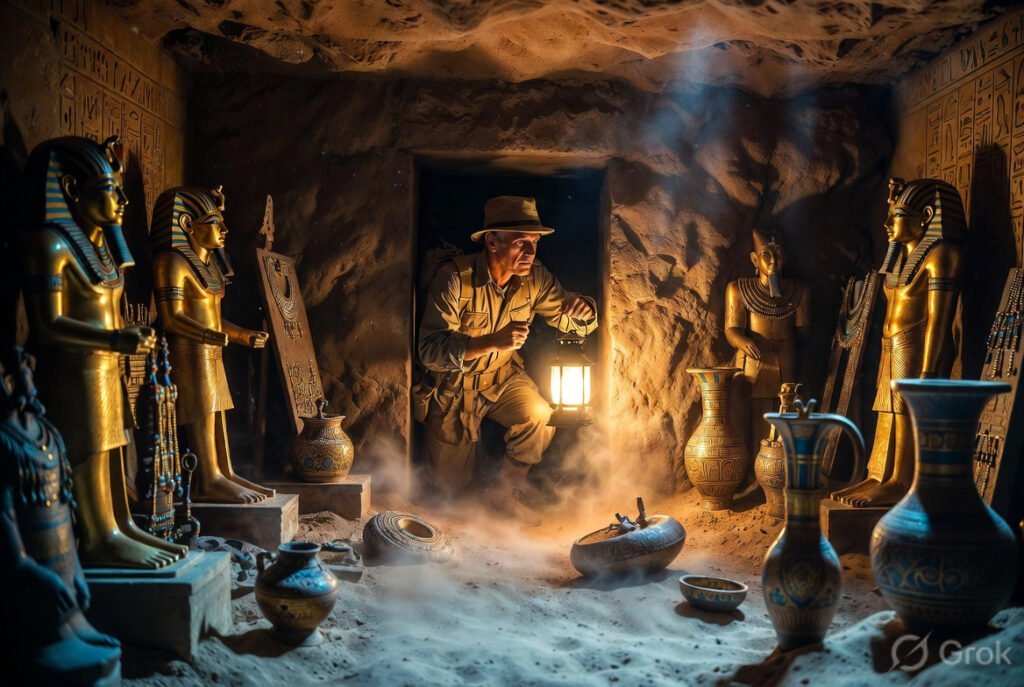
In the sun-baked sands of Egypt’s Valley of the Kings, on November 4, 1922, British archaeologist Howard Carter made a discovery that would captivate the world. Peering through a small hole into a sealed chamber, he famously whispered, “Wonderful things!” What he found was the nearly intact tomb of a young pharaoh who had ruled more than 3,300 years earlier. That pharaoh was Tutankhamun – known today in some Hindi-speaking circles as “Total Khaman” because of how his name sounds when spoken aloud. But this is no joke or meme. Tutankhamun was a real historical figure whose short life, hidden struggles, and extraordinary tomb have revealed more about ancient Egypt than any other discovery in history.
Born around 1341 BCE during the 18th Dynasty, Tutankhamun ascended the throne at just eight or nine years old and died before his 20th birthday, around 1323 BCE. His reign lasted only about nine years, yet it marked one of the most important turning points in Egyptian history: the full restoration of traditional polytheistic worship after the radical monotheistic experiment of his father, Akhenaten. Thanks to modern science – CT scans in 2005, DNA analysis in 2010, and ongoing research through 2025 – we now know his story in astonishing detail, from the genetic curses of royal inbreeding to the true cause of his death.
A Royal Family Plagued by Inbreeding
Tutankhamun was born Tutankhaten (“living image of Aten”) into one of the most controversial royal families Egypt had ever seen. His father was the pharaoh Akhenaten, who had upended centuries of tradition by abandoning the worship of Amun and other gods in favor of a single sun-disk deity called Aten. Akhenaten moved the capital to a new city, Amarna, and promoted a revolutionary style of art that showed the royal family with elongated features and intimate family scenes.
DNA testing published in the Journal of the American Medical Association (JAMA) in 2010 by Zahi Hawass and an international team proved something shocking: Tutankhamun’s parents were full brother and sister. His mother was the mysterious “Younger Lady” mummy from KV35 tomb – confirmed to be Akhenaten’s full sister and daughter of Amenhotep III and Queen Tiye. This extreme inbreeding, common in Egyptian royalty to keep the bloodline “pure,” left Tutankhamun with serious genetic vulnerabilities. He married his own half-sister, Ankhesenamun (daughter of Akhenaten and the famous Queen Nefertiti). The couple had two daughters, but both were stillborn – one at five to six months of gestation and the other at nine months. Their tiny mummified bodies were placed in Tutankhamun’s tomb, a heartbreaking detail discovered in 1922.
Childhood, Coronation, and the Great Restoration
After Akhenaten’s death, two short-lived rulers (possibly Smenkhkare and Neferneferuaten) briefly held the throne. Then, around 1332 BCE, the boy Tutankhaten was crowned pharaoh at Memphis. Real power lay with two powerful advisors: the vizier Ay (who later became pharaoh) and the general Horemheb (who would succeed Ay and erase much of the Amarna period from official records).
In his third regnal year, the young king made a dramatic change. He changed his name to Tutankhamun (“living image of Amun”) and issued the famous Restoration Stela, still visible today at Karnak Temple. The stela declares: “The temples of the gods and goddesses, from Elephantine to the marshes of the Delta, had fallen into ruin… If one prayed to a god… he would never come at all.” Tutankhamun ordered the repair of temples across Egypt, reopened the priesthoods of Amun, and moved the royal court back from Amarna to Thebes (modern Luxor). He commissioned new statues, sphinx avenues, and a grand colonnade at Luxor Temple. In Nubia and the Near East, he oversaw small military campaigns and diplomatic gifts, helping restore Egypt’s regional influence after Akhenaten’s isolationist years.
Despite his youth and physical frailty, Tutankhamun left a lasting mark: he healed a divided kingdom and returned Egypt to its ancient gods.
Health Struggles: A Frail Body in a Powerful Role
Modern imaging tells a tragic story. The 2005 CT scan revealed Tutankhamun suffered from a cleft palate, mild scoliosis, and necrosis (bone death) in his left foot – likely Kohler’s disease or similar conditions caused by inbreeding. He had over 130 walking sticks in his tomb, many of which show signs of use. DNA analysis in 2010 detected multiple strains of the deadliest form of malaria (Plasmodium falciparum). Recent 2025 studies reaffirm that these genetic weaknesses, combined with malaria and a recent leg fracture (possibly from a fall), created a perfect storm.
He was not the strong warrior-king of later pharaohs. Instead, he was a teenager who relied on canes, yet still participated in hunting and state rituals while seated.
The Sudden Death at Age 19
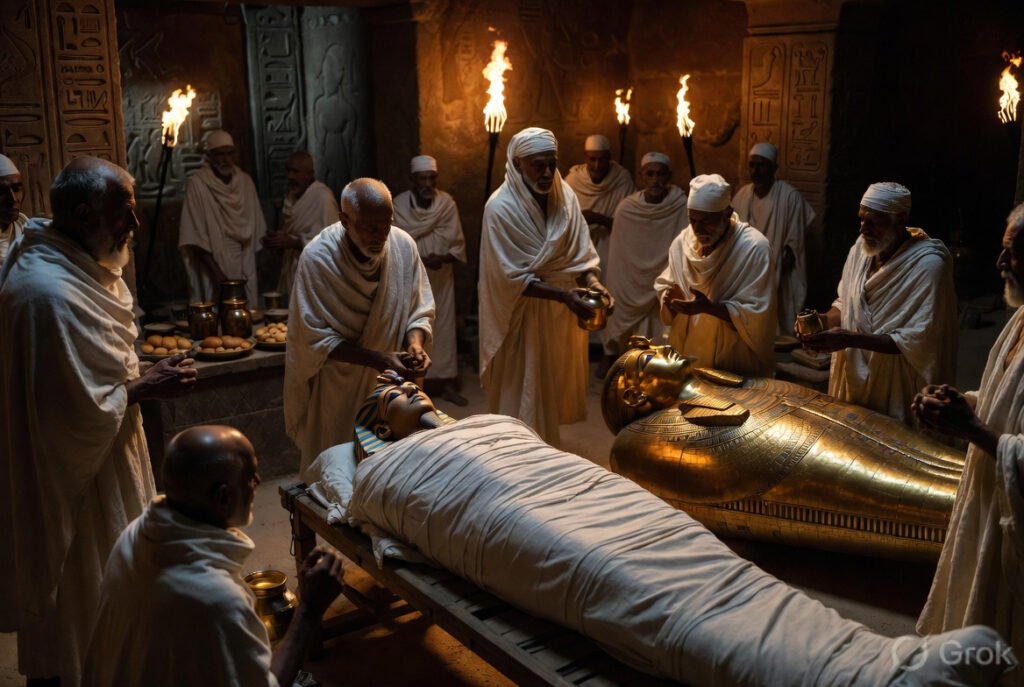
Tutankhamun died around 1323 BCE, probably in his 19th year. There was no murder, no chariot crash (a theory debunked by CT scans showing the chest damage was from modern unwrapping). The 2010 study and 2025 confirmations point to a combination of severe malaria infection, the unhealed leg fracture leading to possible sepsis, and his underlying genetic frailty. Because his death was sudden, he was buried in a small, originally non-royal tomb (KV62) that was quickly adapted. His intended larger tomb remained unfinished.
The 1922 Discovery and the Treasures of KV62
Carter and his sponsor, Lord Carnarvon, had been digging in the Valley of the Kings for years. On November 26, 1922, they opened the burial chamber. Inside were four nested shrines, three coffins (the innermost solid gold, weighing 110 kg), and over 5,400 artifacts – the richest royal tomb ever found intact.
Key treasures included:
- The world-famous gold death mask (11 kg of pure gold inlaid with lapis lazuli, carnelian, turquoise, and obsidian).
- Six chariots, thrones (including one showing the king with Ankhesenamun), beds, clothing, food, wine, and jewelry.
- A dagger made of meteorite iron.
- The two stillborn daughters’ mummies.
- Canopic jars, shabti statues, and ritual objects.
Today, most items are displayed in the Grand Egyptian Museum in Giza.
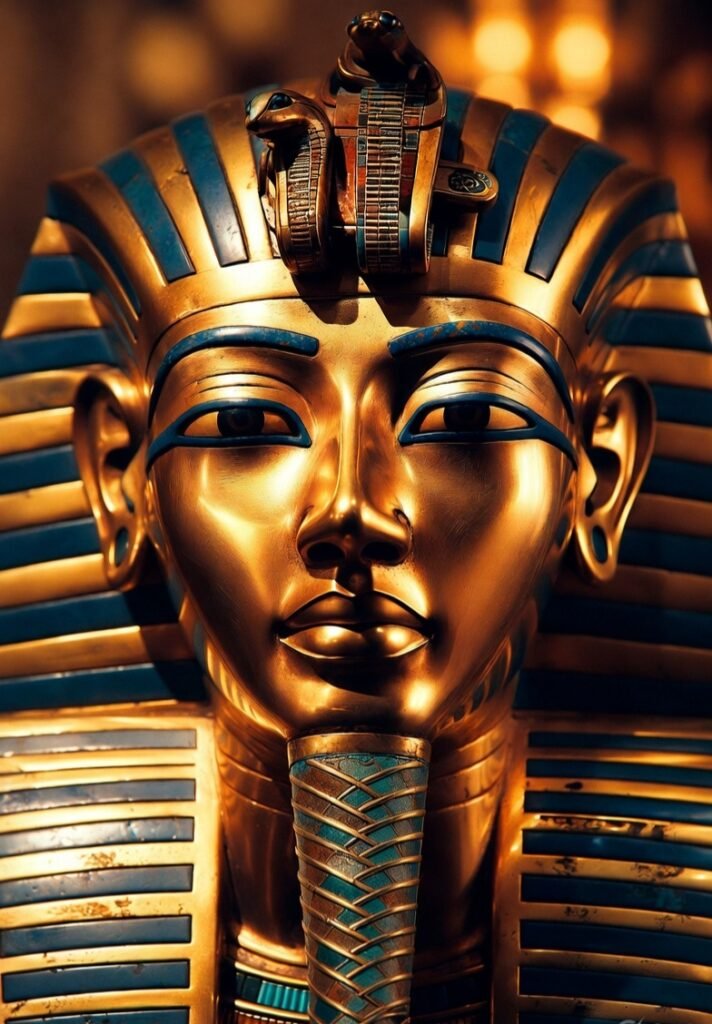
The Myth of the Pharaoh’s Curse
Newspapers quickly invented the “Curse of the Pharaohs” after Lord Carnarvon died in 1923 from pneumonia and blood poisoning (he was already ill before the discovery). Stories of lights going out in Cairo, a cobra eating Carnarvon’s canary, and mysterious deaths spread worldwide. In reality, of the 58 people present at the tomb’s opening, only eight died within a dozen years. Howard Carter himself lived until 1939 at age 64. No curse inscription existed in the tomb. Scientists later suggested possible ancient bacteria or fungus, but nothing supernatural. The “curse” was pure media hype.
Modern Science and Tutankhamun’s Enduring Legacy
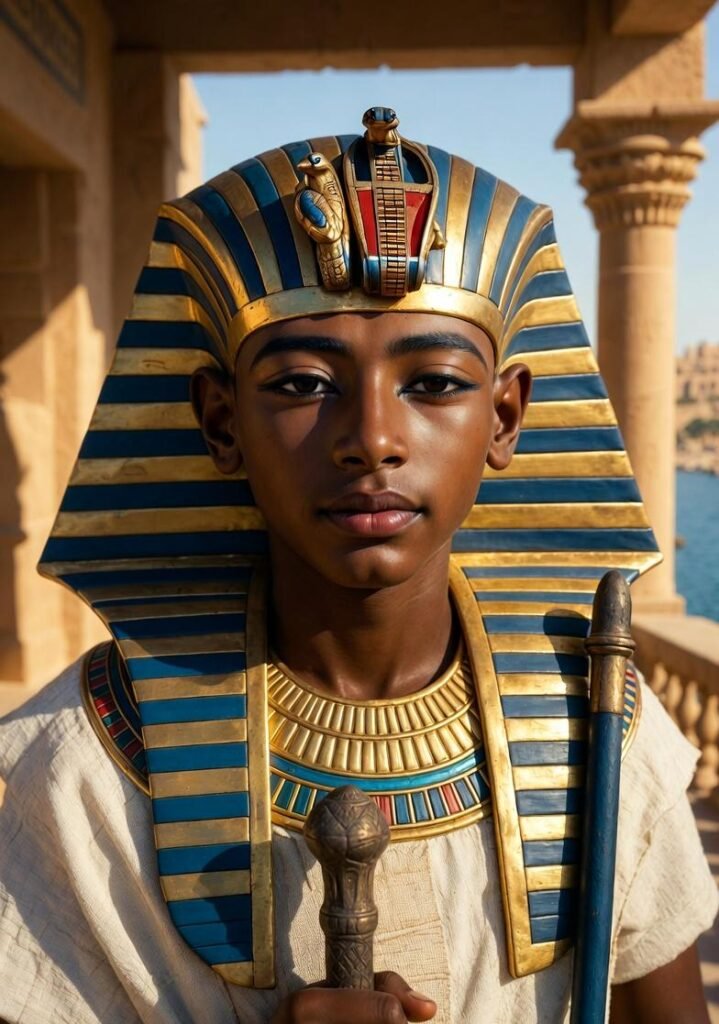
2023 brought a new 3D facial reconstruction by Brazilian, Australian, and Italian experts using the 2005 CT data. It shows a soft-featured young man with dark olive skin, almond eyes, full lips, and a slight overbite – more like a thoughtful student than a stern ruler.
Tutankhamun’s name was deliberately omitted from later king lists by Horemheb and Ramesses II as part of damnatio memoriae. Yet his intact tomb made him immortal. Exhibitions in the 1960s–1970s sparked global “Tut-mania.” Today, his story helps us understand the Amarna period, royal health, ancient medicine, and the power of archaeology.
If this story of the Boy King has left you wanting more – whether about the latest DNA breakthroughs, the full catalog of his treasures, or the ongoing work at the Grand Egyptian Museum – there will be another detailed article coming soon. Tutankhamun’s legacy is far from over; every new scan and study reveals fresh secrets from 3,300 years ago.
Egypt’s sands still hold mysteries, and the young pharaoh who once needed walking sticks to stand now stands tall in the imagination of the world. 🇪🇬